

Projects

Projects -FAQ & Blog

Have Questions?

With the growing popularity of solar energy, many people are curious about the solar technology, installation & Commissioning process, service support, technology involved,  financial aspects and the savings they can expect. We’ve compiled answers to the most common FAQ and Blog to help you better understand how solar power can work for you.

A rooftop solar system uses solar panels installed on your roof to generate electricity from sunlight, which can be used to power your home or business.

Yes, many regions offer net metering, where you earn credits for the electricity your system feeds into the grid.

Reduced electricity bills, environmental impact, energy independence, and potential for government incentives.

It generates power from solar panels and sends excess energy to the grid. In return, you receive credits or compensation for the electricity sent back.

No, you don’t need batteries for an On-Grid system, as the grid serves as the backup power source.

While On-Grid systems don’t require batteries, some utility companies may allow you to store excess power or offer net metering credits.

The system automatically shuts off for safety reasons when there is a grid failure, to prevent back-feeding power and harming utility workers.

Yes, you will still receive a bill, but it will be lower due to the energy your system produces. You only pay for the net consumption from the grid.

 Yes, many regions offer net metering, where you earn credits for the electricity your system feeds into the grid.

Yes, On-Grid systems can be installed on smaller roofs, but the energy generation will depend on the number and efficiency of panels installed.

An Off-Grid system is independent of the utility grid and stores power in batteries for use when the sun isn’t shining.

Yes, a battery is essential to store the energy generated during the day for use at night or during cloudy days.

The battery size depends on your daily energy consumption and the number of sun hours available in your area.

Off-Grid systems require regular maintenance, particularly the batteries. They should be checked periodically for efficiency and wear.

Yes, but it depends on your energy needs and storage capacity. You’ll need enough panels and battery storage to handle your electricity requirements.

If your batteries run out of charge, you may not have power until they are recharged, either from the sun or a backup generator.

Depending on the type and usage, Off-Grid batteries typically last at present to 3 to 5 years.

Yes, Off-Grid systems are ideal for remote locations without reliable access to the utility grid.

A Hybrid solar system combines both an On-Grid and Off-Grid system, allowing you to store excess power in batteries and also send power to the grid.

A Hybrid system provides the benefits of both, offering grid backup when needed and battery storage for autonomy.

Yes, if you have a battery system integrated with your Hybrid system, you can continue using stored power during grid outages.

Battery storage stores excess solar power during the day, which can be used when needed, especially during grid failures or high energy demand periods.

A Hybrid system includes a battery storage component, while a regular On-Grid system does not, relying solely on the grid for backup power.

On average, you need about 100-150 square feet of roof space per kilowatt (kW) of solar panels.

The cost depends on the system size, location, and type (On-Grid, Off-Grid, or Hybrid).Depending on the capacity required, quotation can be submitted. 

Solar projects can be financed through bank loans, government certified organization, or leasing options. Some states offer incentives and rebates that help reduce the upfront cost.

Savings vary based on your energy consumption, system size, and local utility rates. On average, residential systems can save 70-80% on monthly electricity bills, with full ROI within 3 to 5 years.

Solar power reduces electricity bills, minimizes carbon footprint, enhances energy independence, and adds value to your property. It’s a long-term investment that supports sustainability.

A modern earthing system must be:

  • 🔧 Designed based on soil resistivity and fault level
  • 🧪 Installed with certified, inert, and tested conductive material
  • 📉 Able to maintain stable resistance over decades
  • 🛑 Corrosion-free, chemical-free, and maintenance-free
  • 🧾 Documented with test results and compliance certificate

Solar systems require minimal maintenance but regular cleaning of panels and occasional checks on inverters and batteries (if applicable) to ensure optimal performance. 

Advanced technologies like TOPCon panels, microinverters, and smart monitoring systems boost solar efficiency, ensuring higher energy output, even under partial shading or low-light conditions.

For On-Grid systems, power is not available during outages unless paired with a battery. Off-Grid and Hybrid systems provide backup power during grid failures, depending on battery capacity.

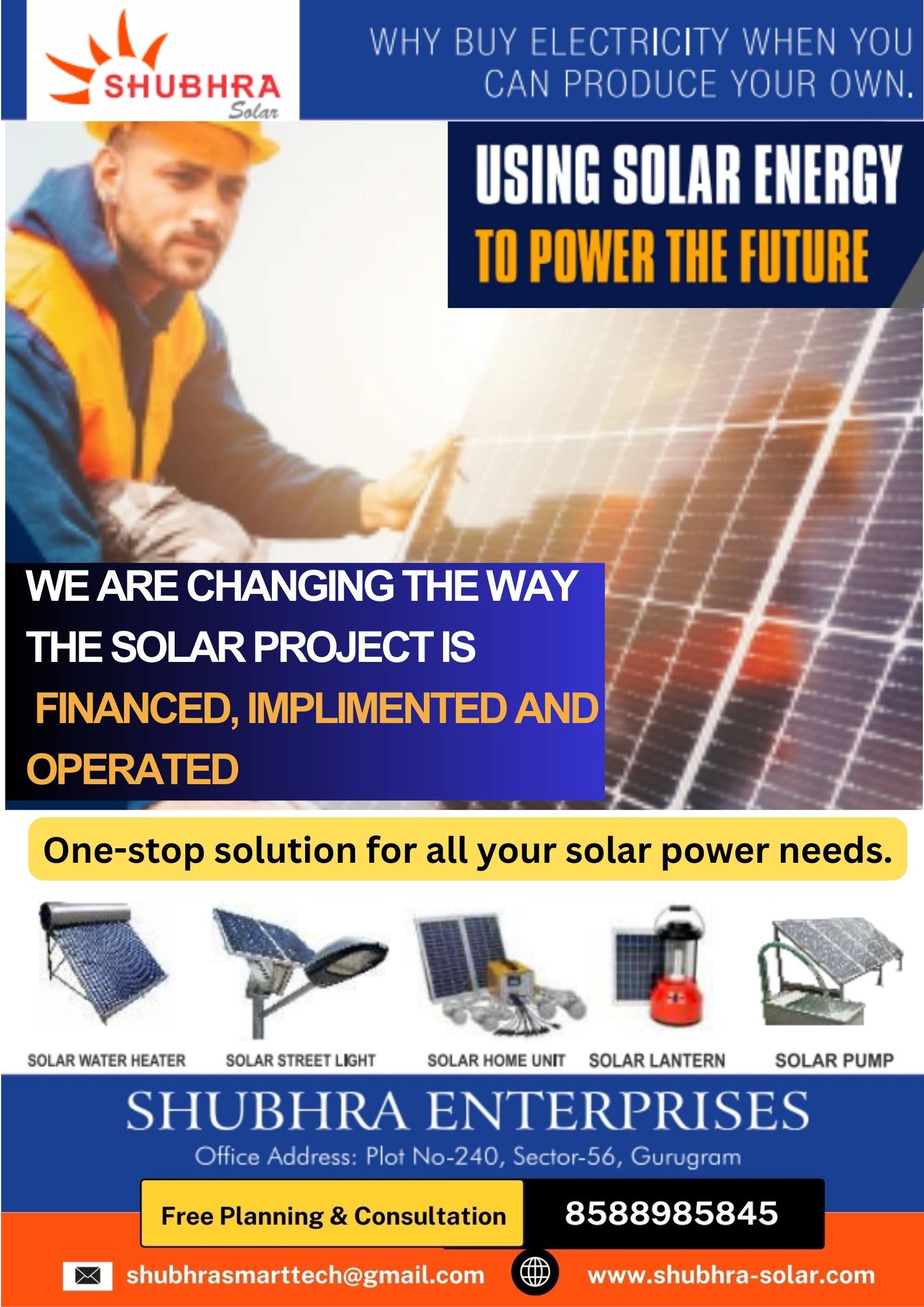
We provide end-to-end solar solutions including site assessment, system design, financing guidance, installation, and long-term maintenance—tailored for residential, commercial, and industrial needs. 

We combine high-quality products from top solar brands with unmatched last-mile service, transparent pricing, and personalized support to ensure real long-term value.

Yes. We help customers access bank loans, EMI options, and government-backed financing schemes for residential and commercial solar projects.

Yes. We handle all necessary approvals, including net metering applications and local DISCOM permissions, on your behalf.


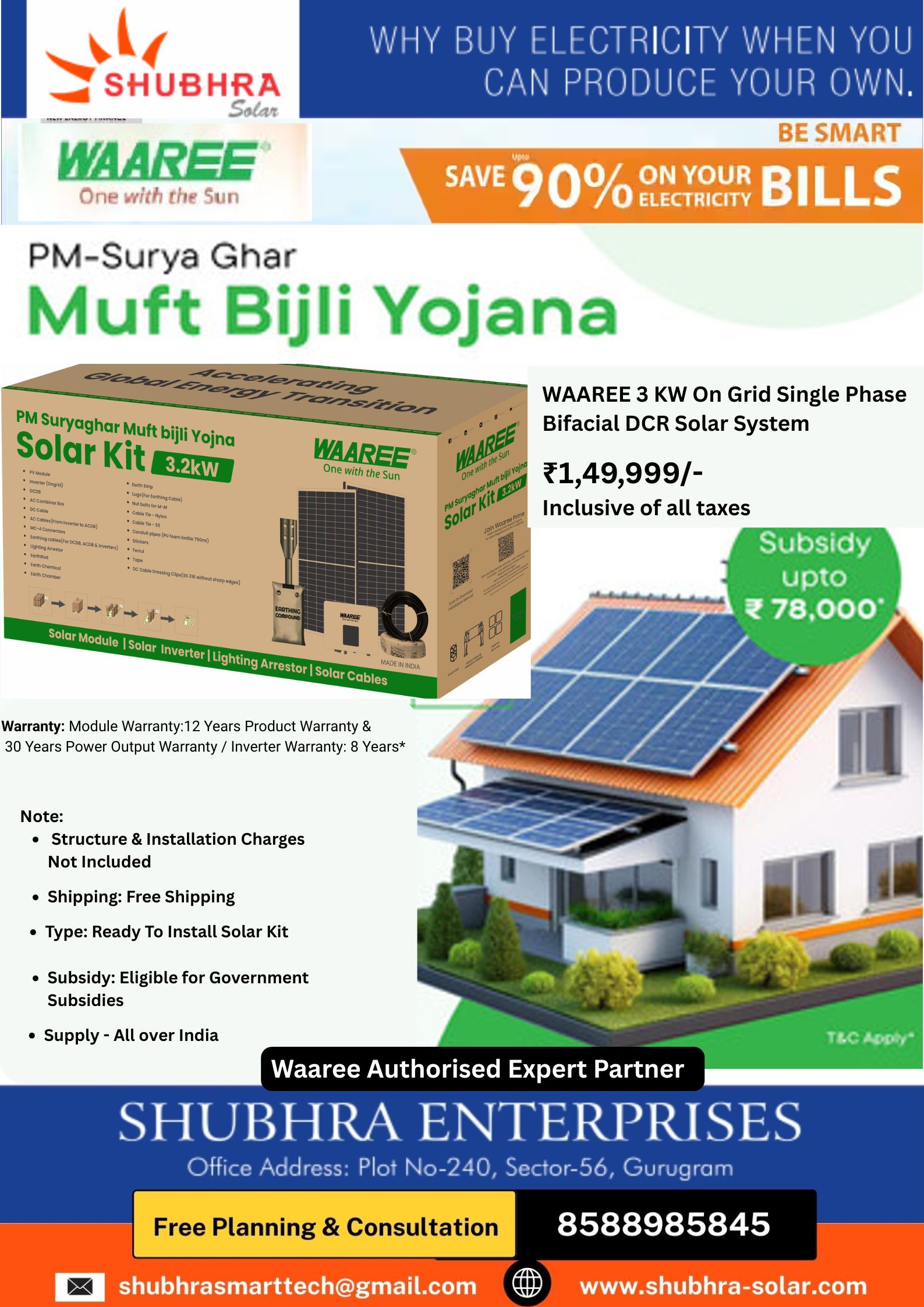
Shubhra Solar does not process or offer government subsidies. We focus on delivering high-quality, cost-effective solar solutions with transparent pricing and excellent last-mile service, regardless of subsidies.

Since we use Non-DCR modules, our systems do not qualify under MNRE subsidy schemes.

  • DCR (Domestic Content Requirement): Solar modules made with cells and panels manufactured in India. Required for subsidy eligibility.
  • Non-DCR: Modules made using imported solar cells (panels may be assembled in India or abroad). Not eligible for subsidies.

Lower Cost:
Non-DCR modules can be 10–20% cheaper, which directly reduces your project cost.

Higher Efficiency:
Imported (Non-DCR) panels often have better conversion efficiency (20–21%) than many domestic options.

Wider Availability:
Non-DCR panels have better stock availability and faster delivery timelines.

Quicker Payback:
Because of lower upfront cost and similar performance, payback period is shorter even without subsidy.

We focus on:

  • Faster execution
  • Competitive pricing
  • Premium service
  • Honest, transparent delivery

We don’t want delays due to approvals, and unpredictable disbursements. We choose to provide value through service, not paperwork.

Yes,as Non DCR panel are cheaper than DCR,
With smart design, quality components, and reliable service, you still achieve 4–5 year payback on capital investment and more than 20+ years of savings, even without subsidy.


India — Grid-connected Rooftop Solar (selected years, cumulative)


YearRooftop cumulative (approx.)Comment / source
2005~0.01 GW (estimate, negligible)Solar rooftop sector was essentially nascent — no central published rooftop totals. (estimate — industry nascent).
2008~0.02 GW (estimate)Very small early pilots and off-grid; no central rooftop programme scale yet.
2011~0.05 GW (estimate)Early commercial/industrial pilots only; grid-connected rooftop market very small.
2014<0.1 GW (estimate)Total solar (all types) was ~2.82 GW by 2014 (MNRE) — rooftop share was tiny then. Ministry of New and Renewable Energy
2017~0.86 GW (≈863–984 MW)Rooftop installations picked up — MNRE / Govt commentary and industry reporting show cumulative rooftop under 1 GW around 2017. Saur Energy+1
2018~3.85 GW (Dec 2018, industry estimate)Industry analyses recorded a noticeable jump by end-2018 (~3.8–3.9 GW rooftop). IEEFA
2020~4–5 GW (industry estimate)Slow but steady growth; COVID & policy changes affected yearly additions. (see IEEFA / MNRE trend notes). IEEFA+1
2022~8.8 GW (end-2022, industry reporting)Multiple industry outlets reported cumulative rooftop ≈8.8 GW by end-2022. Wikipedia
2023 (mid/Jul)~10.9 GW (July 2023, industry estimate)IEEFA / industry reporting estimated ~10.9 GW cumulative by mid-2023. IEEFA
2024 (Dec)~18.4 GW (Dec-2024, Bridge To India / market reports)Industry trackers reported a large jump in 2024 (strong policy + subsidy pushes). BRIDGE TO INDIA
2025 (Aug)~20.8 GW (as on 31-Aug-2025, MNRE physical progress)Official MNRE physical progress page lists Grid-connected rooftop ≈20.85 GW (Aug-2025).
Think Over It

Why Rooftop Solar Will Be Essential — Not Optional — in the Coming Decades

Electricity demand is set to multiply in the coming 20–25 years.

In India, with electricity rates rising steadily and the demand for power multiplying more than 100 times in the last two decades, the world is facing an urgent need for cleaner and more sustainable energy sources. Fossil fuels are not only depleting rapidly but also driving climate change through harmful emissions.

Rooftop solar has emerged as the most practical, cost-effective, and scalable solution — harnessing free sunlight to produce clean energy right where it’s needed. Once installed, solar systems drastically cut or even eliminate electricity bills, while requiring minimal maintenance.

As energy demand surges, switching to solar isn’t just a smart financial choice — it’s a vital step toward energy independence and environmental responsibility.

Rapid growth in every sector — electric vehicles, AI-driven industries, data centers, automation, cooling/heating, and smart homes — will all need huge amounts of power.

But India’s DISCOM (grid) supply is not expanding at the same pace.
We are already seeing:

  • Power deficits during peak summer and evening loads

  • Brownouts/blackouts in high-demand zones

  • Rising electricity tariffs to recover infrastructure costs

  • Transmission & distribution losses that waste 18–20% of generated power

As demand outstrips supply, grid electricity will become costlier, unreliable, and prone to outages.

☀️ How Rooftop Solar Provides Relief

  • Self-generation = energy security
    Homes and businesses with rooftop solar are insulated from grid blackouts.

  • Lower lifetime cost
    Once installed, solar power is free for 20+ years — while grid rates rise every year.

  • EV-ready homes
    With EVs set to become mainstream, charging from your own solar array cuts dependence on costly grid power.

  • Environmental relief
    Clean energy reduces load on fossil-fuel power plants and helps meet climate targets.


⚡ The Bottom Line

If homes and businesses don’t start generating their own electricity, they will face:

  • Power shortages

  • Tariff shocks

  • Blackouts during peak load times

Rooftop solar is no longer a luxury — it’s the backup plan that pays for itself and ensures you stay powered when the grid can’t keep up.

Think Over It

Why Rooftop Solar is Now One of the Smartest Investments

  • Fast Payback, Long Savings — In many parts of India, a rooftop solar system pays for itself in 4–5 years, sometimes even 2–3 years with high subsidies and electricity rates. After that, your electricity is practically free for the next 20+ years. 

  • Shield Against Rising Electricity Costs — With utility rates increasing year after year, generating your own power protects you from unpredictable hikes and hidden costs.

  • Government Support & Incentives — Subsidies, net‐metering, and tax benefits already in place dramatically reduce your capital outlay and improve returns.

  • Low Maintenance, High Reliability — Once installed, rooftop solar systems require minimal upkeep. Quality panels have 20-25 year warranties; maintenance is simple (cleaning, periodic checks). 

  • Environmental & Energy Independence Benefits — You reduce your carbon footprint, become less dependent on grid and DISCOM challenges (blackouts, rising tariffs), and gain real energy security.


Ready to Save Big & Own Your Power?

Send us your electricity bill or details of your current power usage. We’ll show you exactly how rooftop solar can match your bill as EMIs, deliver free electricity for decades, and give you a clear path to being energy independent.

Basic ROI Calculation – 10 kW Rooftop Solar System (ON Grid)

ItemValue
System Size10 kW
Average Cost (with GST)₹50,000 per kW → ₹5,00,000
  
  
Average Generation per Year10 kW × 4 units/day × 365 = 14,600 units
Tariff Saved (₹8/unit)14,600 × ₹8 = ₹1,16,800 per year
Maintenance Cost/Year₹3,000–5,000 (negligible)
Payback Period₹3,83,000 ÷ ₹1,16,800 ≈ 3.3 years
System Life25 years (performance warranty)
Post-Payback Savings21.7 years × ₹1,16,800 ≈ ₹25+ lakh

✅ Conclusion: One-time investment recovers in ~3–4 years and gives over more than 20 years free electricity in its lifetime.

Shubhra Enterprises’ Role

Here’s how we remove adoption barriers and enable smooth execution:

  • Financial Tie-ups — We coordinate with partner banks/NBFCs to fast-track approvals under PMEGP or rooftop solar schemes. We prepare all paperwork and risk assessments.

  • Site Feasibility & ROI Proposal — We assess roof structure, load capacity, shadow analysis, and present clear ROI projections for client + bank.

  • End-to-End EPC Execution — Procurement, installation, commissioning, and net-metering liaison with DISCOMs.

  • Skilled Workforce — In-house trained & accredited installers to meet safety, performance, and warranty standards.

  • Post-Sales Support — Annual maintenance, panel cleaning, performance tracking, and quick warranty claims handling.